Engineering and the Environment

Research Group: Human Sciences Group

The Human Sciences Group comprises the Human Factors Research Unit, the Hearing and Balance Centre, Subjective Acoustics, and the South of England Cochlear Implant Centre.

Currently Active: Yes

Human Factors Research Unit, HFRU:

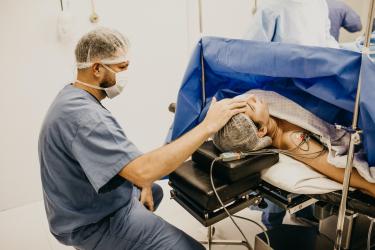
The HFRU is a multidisciplinary unit conducting fundamental and applied research, providing training, and offering advice in all matters related to human responses to vibration: health effects (including the hand-arm vibration syndrome), discomfort, performance, biodynamics, seating dynamics and motion sickness.

Hearing and Balance Centre, HABC: 

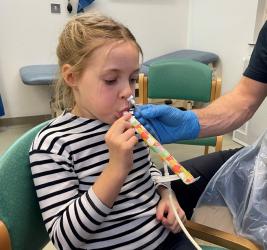
The HABC works to improve the quality of life of patients with hearing and/or balance disorders by combining clinical activities with research and teaching.

The HABC is a multidisciplinary team including Audiologists, Researchers, Speech and Language Therapists, Teachers of the Deaf, ENT Surgeons and Paediatricians.

South of England Cochlear Implant Centre, SOECIC:

More than 800 people have benefited from receiving a cochlear implant in SOECIC.

Subjective Acoustics:

Subjective acoustics is a multi-disciplinary topic concerned with the interface between engineering noise control and human perception.

Contact us

  • ISVR Unit

    Engineering and the Environment
    University of Southampton
    Highfield Campus
    Southampton SO17 1BJ


    Senior administrative officer: Sue Brindle

    Tel: +44 (0)23 8059 2291

    Email: sjb@isvr.soton.ac.uk

Selected publications associated with this group from the University of Southampton's electronic library (e-prints):

Article

Verschuur, C.A., Dowell, Aphra, Syddall, H.E., Ntani, Georgia, Simmonds, S.J., Baylis, D., Gale, C.R., Walsh, B., Cooper, Cyrus, Lord, Janet M. and Sayer, A.A. (2012) Markers of inflammatory status associated with hearing threshold in older people: findings from the Herfordshire ageing study. Age and Ageing, 41, (1), 92-97. (doi:10.1093/ageing/afr140)
Qui, Yi and Griffin, Michael J. (2011) Modelling of fore-and-aft apparent mass of the human body and the transmissibility of seat backrest. Journal of Vehicle System Dynamics, 49, (5), 703-722.
Qiu, Y. and Griffin, M.J. (2011) Apparent mass of the seated human body exposed to single-axis and dual-axis vibration with backrest contact. Journal of Industrial Health (Submitted)
Brockmeier, S.J., Fitzgerald, D., Searle, O., Fitzgerald, H., Grasmeder, M.L., Hilbig, S., Vermiere, K., Peterreins, M., Heydner, S. and Arnold, W. (2011) The MuSIC perception test: A novel battery for testing music perception of cochlear implant users. Cochlear Implants International, 12, (1), 10-20.
Chambers, P., Grabham, N.J., Swabey, M.A., Lutman, M.E., White, N.M., Chad, J.E. and Beeby, S.P. (2011) A comparison of verification in the temporal and cepstrum-transformed domains of transient evoked otoacoustic emissions for biometric identification. International Journal of Biometrics, 3, (3), 246-264. (In Press)
Campos, F., Thorne, J.D., Bleeck, S., Eyles, J.E. and Debener, S. (2011) Evaluating the quality of auditory evoked potentials from cochlear implant users. Psychophysiology (In Press)

Conference or Workshop Item

Wheatley, A.M.H., van Besouw, R.M. and Lutman, M.E. (2011) Music perception testing in UK cochlear implant centres. At British Cochlear Implant Group Conference, Nottingham, GB, 31 Mar - 01 Apr 2011.

Thesis

Thuong, O. (2011) Predicting the vibration discomfort of standing passengers in transport. University of Southampton, Institute of Sound and Vibration Research, Doctoral Thesis, 362pp.

Members of staff associated with this group:

Research projects associated with this group:

A comparison of EquiTest and Nintendo Wii for assessment of sensory integration for postural control

Acoustic landmark detection and speech perception in difficult listening conditions

Acoustic simulations of cochlear implants

Aircraft noise sound quality

Airport noise management

Anthropodynamic dummies

Apparent mass of the human body

Attitudes to noise from aviation sources in England study

Audiology diagnostic strategy

Auditory spatial navigation

Balance

Bayesian modelling of subthalamic activity in offline motor control

Benefits of electroacoustic hearing

Binaural/spatial hearing and learning related to hearing aids and cochlear implants

Biodynamic Responses

Bone-conduction hearing and hearing devices

Chinese triplets telephone hearing tests

Coding strategies in cochlear implants for improved pitch and music perception

Cognitive Behavioural Therapy to treat tinnitus in Cochlear Implant Users

Combined effects of noise and vibration on drivers and passengers

Compositions for cochlear implantees

Cortical response to coded speech sound

COSMA (Community Oriented Solutions to Minimise Aircraft noise Annoyance) EU FP7 Project

Discomfort caused by horizontal (fore-and-aft and lateral) and rotational (roll and pitch) vibration

Discomfort caused by low frequency translational and rotation oscillation

Discomfort of standing persons exposed to vibration

Dynamic performance of car seats

Dynamic performance of suspension seats

EarBot - A binaural sound source localisation robot

Effect of inflammatory proteins on age-related hearing loss

Effects of amplification and reverberation on sound localization

Effects of anaesthesia on auditory evoked potentials

Effects of gloves on the transmission of vibration to the hand

Effects of noise on housing preference

Effects of the inclination of seat backrests on vibration discomfort

Emotional processing: A framework for tinnitus therapy

European CS19 Validation And Normative Data Collection

Evaluate telemedicine in the follow-up of cochlear implant users.

Exploring the experiences of adolescents with cochlear implants

Functional plasticity in bilateral cochlear implants

Glove testing to ISO 10819

Health Effects

Hearing

Hearing prostheses

Hearing Prosthesis: Sparse stimuli for cochlear implants

How do we hear size? Object-size discrimination in the auditory system

HVLab and Services

HVLab diagnostic systems

Ignorability and noticeability of aircraft sounds

Improving single channel noise reduction using sparse coding strategies

Improving the acquisition of Auditory Evoked Potentials for clinical diagnosis

Localization of transient acoustic signals in urban environments

Managing community responses to aircraft noise

Measurement protocols for the Vestibular Evoked Myogenic Potential

Methods of measuring and predicting seat transmissibility

Modelling cochlear dynamics

Modelling of auditory pathway in cochlear implants

Modelling of cabin-seat-driver dynamic systems of off-road vehicles

Modelling Otoacoustic Emission (OAE) Signals

Modelling the dynamic response of the human body

Modelling the dynamic responses of seats

Motion Sickness

Motion sickness caused by low frequency translational and rotational oscillation

Motion sickness in tilting trains

Neural decoding of movement in the human brain

Neuronal responses in the auditory brainstem

Non-linearity in subjective and biodynamic responses to vertical vibration

Objective measures of hearing aid benefit

Perception of phase differences between the seat, the feet, and the hands

Postural stability of walking persons exposed to lateral vibration

Processing and perception of low frequency speech cues for hearing impairment

Quality of life measures for patients with bilateral cochlear implants

Questionnaire study on the musical activities of young listeners

Seat testing to ISO 7096, ISO 10326-2, and other standards

Simulating sensineural hearing loss using Gammachirp filter banks

Simulation of sensorineural hearing loss using Wavelet filter banks

Sound Quality of Exterior Aeroplane Sound

Speech coding by entropy

Speech enhancement based on wavelet transform

Subjective Acoustics: Environmental and Community Noise

Subjective Responses

Tactile channels mediating the perception of supra-threshold vibration

Temporal information in cochlear implants

Thermotactile perception thresholds

Tongue movement as new way of communication for rehabilitation systems

Vascular responses to hand-transmitted vibration

Vibrotactile perception thresholds on the sole of the foot

What are the benefits of multichannel recording of Auditory Evoked Responses

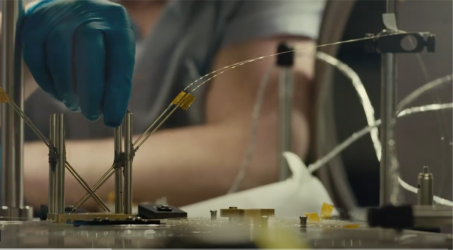
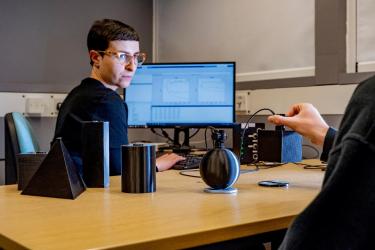
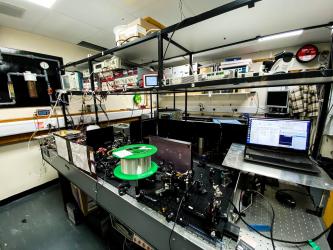
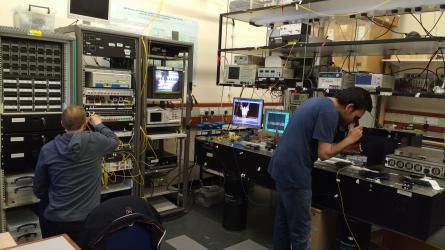
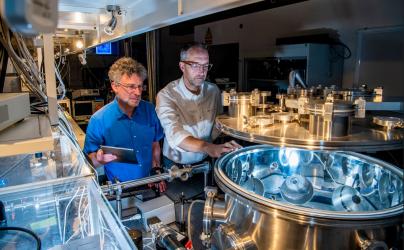
The Human Factors Research Unit laboratories have a unique range of human-related test facilities for experimental studies of human responses to whole-body vibration, hand-transmitted vibration, and low frequency oscillation.